using Pumas
using ModelingToolkit
using StructuralIdentifiability
using AlgebraOfGraphics
using CairoMakie
using DataFramesMeta
using SummaryTables

import Logging
Structural Identifiability Analysis
Which Parameters Can We Estimate from Clinical Measurements?
NoteHBV Tutorial Series
This is Tutorial 3 of 6 in the HBV series.
| # | Tutorial | Status |
|---|---|---|
| 1 | Model Introduction | ✓ Complete |
| 2 | Global Sensitivity Analysis | ✓ Complete |
| 3 | Structural Identifiability (current) | ← You are here |
| 4 | Copula Vpop Generation | |
| 5 | MILP Calibration | |
| 6 | VCT Simulation |
1 Learning Outcomes
For the theory behind structural identifiability (definitions, classifications, why it matters before estimation), see TB-03: Structural Identifiability.
In this tutorial, you will learn:
- How to handle non-rational ODE terms that
StructuralIdentifiability.jlcannot process directly - How to reformulate a Hill function with a non-integer exponent into a rational system via an auxiliary state variable
- How different measurement scenarios affect identifiability in a large QSP model (11 ODEs, 9 estimated parameters)
2 Libraries
3 Part 1: Rational Reformulation of the HBV Model
3.1 The Non-Rational Function Problem
The HBV model from HBV-01 contains a Hill function in the X' equation with a non-integer exponent nS = 0.486:
X' = r_X * (1 - X) * (I / (ϕ_E + I)) *
    (1 - S_max * (HBsAg_ug_mL^nS / (ϕ_S^nS + HBsAg_ug_mL^nS))) - d_X * X
where HBsAg_ug_mL = c * (V + S) is a linear function of state variables V and S and c = 96 · 24000 · 1e6 / 6.022e23 is a known unit-conversion constant.
StructuralIdentifiability.jl requires the ODE right-hand side to be a quotient of polynomials (i.e., rational). The term (V + S)^0.486 violates this requirement.
3.2 Auxiliary Variable Trick
To resolve this problem, we introduce an auxiliary state variable:
\[H(t) = \bigl(c \cdot (V(t) + S(t))\bigr)^{n_S}\]
By the chain rule:
\[H'(t) = n_S \bigl(c \cdot (V(t) + S(t))\bigr)^{n_S - 1} \cdot c \cdot (V'(t) + S'(t)) = n_S \cdot H(t) \cdot \frac{V'(t) + S'(t)}{V(t) + S(t)}\]
Substituting the ODEs for \(V(t)\) (\(V'(t) = p_V \epsilon_\text{NA} \epsilon_\text{IFN} I(t) - d_V V(t)\)) and \(S(t)\) (\(S'(t) = p_S I(t) - d_V S(t)\)):
\[H'(t) = n_S \cdot H \cdot \frac{(p_V \epsilon_\text{NA} \epsilon_\text{IFN} + p_S) I(t) - d_V (V(t) + S(t))}{V(t) + S(t)}\]
This right-hand side is rational in \(H(t)\), \(I(t)\), \(V(t)\), \(S(t)\) and the parameters.
The Hill function in the differential equation for \(X'(t)\) becomes \(H(t) / (\psi + H(t))\) where \(\psi = \phi_S^{n_S}\) is a known constant — also rational.
3.3 Model Definition
We reuse the HBV model from HBV-01 with two modifications:
- The Hill function in
X'is replaced byH / (ψ + H) - An ODE for the auxiliary variable
His added
As in HBV-02, we use I and P directly without the Ieff/Peff threshold switch as such conditionals are not supported by StructuralIdentifiability.jl.
hbv_si_model = @model begin
    @param begin
        # Estimated parameters (log10 scale)
        "Production/synthesis rate of HBsAg subviral particles from infected hepatocytes [molec./cell/d]"
        tv_log10_p_S ∈ RealDomain(; lower = 2, upper = 12)
        "HBV infectivity [mL/virus/d]"
        tv_log10_β ∈ RealDomain(; lower = -10, upper = 0)
        "Killing rate of infected hepatocytes by cellular immunity [mL/cells/d]"
        tv_log10_m ∈ RealDomain(; lower = -3, upper = 5)
        "Synthesis rate of antigen presenting cells [cells/d]"
        tv_log10_k_P ∈ RealDomain()
        "Synthesis rate of ALT from debris hepatocytes [10^3 U/cells/d]"
        tv_log10_k_A ∈ RealDomain()
        "PD efficacy of NA on HBV production []"
        tv_log10_ϵ_NA ∈ RealDomain(; lower = -5, upper = 0)
        "PD efficacy of IFNα on HBV production []"
        tv_log10_ϵ_IFN ∈ RealDomain(; lower = -5, upper = 0)
        "PD efficacy of IFNα on activation of cellular immunity []"
        tv_log10_r_E_IFN ∈ RealDomain(; lower = 0, upper = 4)
        "Scaling factor for observed effector CD4/8 T cell numbers []"
        tv_log10_conv_E ∈ RealDomain()

        # IIV of estimated parameters in log10 scale
        Ω ∈ PDiagDomain(9)

        # Fixed parameters
        "Baseline of HBV [copies/mL]"
        ini_V ∈ RealDomain(; lower = 0.0)
        "Baseline of ALT [U/L]"
        ini_A ∈ RealDomain(; lower = 0.0)
        "Max. proliferation rate of uninfected hepatocytes [1/d]"
        r_T ∈ RealDomain(; lower = 0.0)
        "Max. proliferation rate of cellular immunity [1/d]"
        r_E ∈ RealDomain(; lower = 0.0)
        "Max. proliferation rate of innate immunity [1/d]"
        r_X ∈ RealDomain(; lower = 0.0)
        "Fraction of cellular immunity that killing uninfected and refractory cells []"
        n ∈ RealDomain(; lower = 0.0)
        "Max. rate of conversion of infected cells to refractory cells due to the action of innate immunity [1/d]"
        ρ ∈ RealDomain(; lower = 0.0)
        "Max. rate of conversion of refractory cells back to target cells in the absence of innate immune responses []"
        ρ_o_ρ_r ∈ RealDomain(; lower = 0.0)
        "Production/synthesis rate of HBV from infected hepatocytes [virus/cell/d]"
        p_V ∈ RealDomain(; lower = 0.0)
        "Death rate of infected hepatocytes [1/d]"
        d_TI ∈ RealDomain(; lower = 0.0)
        "Degradation/clearance of HBV HBsAg subviral particles [1/d]"
        d_V ∈ RealDomain(; lower = 0.0)
        "Rate of systemic induction/recovery from exhaustion [1/d]"
        d_Q ∈ RealDomain(; lower = 0.0)
        "Degradation/clearance of innate immunity [1/d]"
        d_X ∈ RealDomain(; lower = 0.0)
        "Degradation/clearance of cellular immunity [1/d]"
        d_E ∈ RealDomain(; lower = 0.0)
        "Degradation/clearance of antigen presenting cells [1/d]"
        d_P ∈ RealDomain(; lower = 0.0)
        "Degradation/clearance of debris [1/d]"
        d_D ∈ RealDomain(; lower = 0.0)
        "Degradation/clearance of ALT [1/d]"
        d_A ∈ RealDomain(; lower = 0.0)
        "Max. rate of exhaustion [1/d]"
        d_E_Q ∈ RealDomain(; lower = 0.0)
        "Hepatocyte carrying capacity in the liver [cells/mL]"
        T_max ∈ RealDomain(; lower = 0.0)
        "Half-maximal (saturation) parameter for the effect of systemic exhaustion []"
        ϕ_Q ∈ RealDomain(; lower = 0.0)
        "Half-maximal (saturation) parameter for the activation of cellular immunity [cells/mL]"
        ϕ_E ∈ RealDomain(; lower = 0.0)
        "Max. inhibitory effect of HBsAg subviral particles on innate immunity []"
        S_max ∈ RealDomain(; lower = 0.0)
        "Half-maximal (saturation) parameter for inhibitory effect of HBsAg subviral particles on the generation of innate immunity [μg/mL]"
        ϕ_S ∈ RealDomain(; lower = 0.0)
        "Hill coefficient for describing HBsAg-induced inhibition of innate immunity []"
        nS ∈ RealDomain()

        # Residual errors
        σ_add_log10_HBsAg ∈ RealDomain(lower = 0.0)
        σ_prop_log10_HBsAg ∈ RealDomain(lower = 0.0)
        σ_add_log10_HBV ∈ RealDomain(lower = 0.0)
        σ_prop_log10_HBV ∈ RealDomain(lower = 0.0)
        σ_prop_log10_ALT ∈ RealDomain(lower = 0.0)
        σ_prop_log10_CD8 ∈ RealDomain(lower = 0.0)
    end

    @random begin
        η ~ MvNormal(Ω)
    end

    @covariates NA IFN

    @pre begin
        # Logit-normal distribution of log10(p_S), scaled to range [2, 12]
        p_S = exp10(10 * logistic(logit((tv_log10_p_S - 2) / 10) + η[1]) + 2)
        # Logit-normal distribution of log10(β), scaled to range [-10, 0]
        β = exp10(10 * (logistic(logit(tv_log10_β / 10 + 1) + η[2]) - 1))
        # Logit-normal distribution of log10(m), scaled to range [-3, 5]
        m = exp10(8 * logistic(logit((tv_log10_m + 3) / 8) + η[3]) - 3)
        # Normal distribution of log10(k_P)
        k_P = exp10(tv_log10_k_P + η[4])
        # Normal distribution of log10(k_A)
        k_A = exp10(tv_log10_k_A + η[5])
        # Logit-normal distribution of log10(ϵ_NA), scaled to range [-5, 0]
        ϵ_NA = exp10(NA * 5 * (logistic(logit(tv_log10_ϵ_NA / 5 + 1) + η[6]) - 1))
        # Logit-normal distribution of log10(ϵ_IFN), scaled to range [-5, 0]
        ϵ_IFN = exp10(IFN * 5 * (logistic(logit(tv_log10_ϵ_IFN / 5 + 1) + η[7]) - 1))
        # Logit-normal distribution of log10(r_E_IFN), scaled to range [0, 4]
        r_E_IFN = exp10(IFN * 4 * logistic(logit(tv_log10_r_E_IFN / 4) + η[8]))
        # Normal distribution
        conv_E = exp10(tv_log10_conv_E + η[9])

        # Precompute ψ = ϕ_S^nS for the rational Hill function
        ψ = ϕ_S^nS
    end

    @init begin
        V = ini_V
        I = d_V * ini_V / p_V
        T = T_max - d_V * ini_V / p_V
        S = p_S * ini_V / p_V
        A = ini_A
        H = (96 * 24000.0e6 / 6.022e23 * (ini_V + p_S * ini_V / p_V))^nS
    end

    @dynamics begin
        T' = -β * V * T + r_T * T * (1 - (T + I + R) / T_max) -
            d_TI * T + ρ_o_ρ_r * R - (m / n) * r_E_IFN * E * T
        I' = β * V * T + r_T * I * (1 - (T + I + R) / T_max) -
            ρ * X * I - d_TI * I - m * r_E_IFN * E * I
        R' = ρ * X * I - ρ_o_ρ_r * R + r_T * R * (1 - (T + I + R) / T_max) -
            d_TI * R - (m / n) * r_E_IFN * E * R
        D' = m * r_E_IFN * E * I + (m / n) * r_E_IFN * E * (T + R) - d_D * D
        A' = d_A * (ini_A - A) + k_A * D
        S' = p_S * I - d_V * S
        V' = p_V * I * ϵ_NA * ϵ_IFN - d_V * V
        P' = k_P * (I / (ϕ_E + I)) - d_P * P
        E' = (d_E + r_E * E) * P - d_E_Q * E * (Q^4 / (ϕ_Q^4 + Q^4)) - d_E * E
        Q' = d_Q * (P - Q)

        # MODIFIED: rational Hill function via auxiliary variable H
        X' = r_X * (1 - X) * (I / (ϕ_E + I)) *
            (1 - S_max * (H / (ψ + H))) - d_X * X

        # NEW: auxiliary variable H = (c * (V + S))^nS
        H' = nS * H * ((p_V * ϵ_NA * ϵ_IFN + p_S) * I - d_V * (V + S)) / (V + S)
    end

    @vars begin
        f_molec2ug := 24000 * 1.0e6 / 6.022e23
        HBsAg_ug_mL := 96 * (V + S) * f_molec2ug
    end

    # Error models: Values are log10-transformed
    @derived begin
        "HBsAg [IU/mL]"
        log10_HBsAg ~ @. CombinedNormal(log10(max(0, HBsAg_ug_mL) / 0.98e-3), σ_add_log10_HBsAg, σ_prop_log10_HBsAg)

        "Viral load [copies/mL]"
        log10_HBV ~ @. CombinedNormal(log10(max(0, V)), σ_add_log10_HBV, σ_prop_log10_HBV)

        "ALT [U/L]"
        log10_ALT ~ @. ProportionalNormal(log10(max(0, A)), σ_prop_log10_ALT)

        "CD8+ T cell counts [cells/mL]"
        log10_CD8 ~ @. ProportionalNormal(log10(conv_E * max(0, E)), σ_prop_log10_CD8)
    end
end
PumasModel
Parameters: tv_log10_p_S, tv_log10_β, tv_log10_m, tv_log10_k_P, tv_log10_k_A, tv_log10_ϵ_NA, tv_log10_ϵ_IFN, tv_log10_r_E_IFN, tv_log10_conv_E, Ω, ini_V, ini_A, r_T, r_E, r_X, n, ρ, ρ_o_ρ_r, p_V, d_TI, d_V, d_Q, d_X, d_E, d_P, d_D, d_A, d_E_Q, T_max, ϕ_Q, ϕ_E, S_max, ϕ_S, nS, σ_add_log10_HBsAg, σ_prop_log10_HBsAg, σ_add_log10_HBV, σ_prop_log10_HBV, σ_prop_log10_ALT, σ_prop_log10_CD8
Random effects: η
Covariates: NA, IFN
Dynamical system variables: T, I, R, D, A, S, V, P, E, Q, X, H
Dynamical system type: Nonlinear ODE
Derived: log10_HBsAg, log10_HBV, log10_ALT, log10_CD8
Observed: log10_HBsAg, log10_HBV, log10_ALT, log10_CD83.4 Extract ODE System
ode_system = hbv_si_model.sysModel ##Pumas#232: Equations (12): 12 standard: see equations(##Pumas#232) Unknowns (12): see unknowns(##Pumas#232) T(t) I(t) R(t) D(t) ⋮ Parameters (33): see parameters(##Pumas#232) ini_V ini_A r_T r_E ⋮
4 Part 2: Running Identifiability Analysis
4.1 Define Measurement Scenarios
We define three clinically motivated scenarios. Monotonic transformations (log₁₀) and known scaling constants do not affect structural identifiability, so we use the raw state variables as measurements.
t = ModelingToolkit.independent_variable(ode_system)
@variables y_HBsAg(t) y_HBV(t) y_ALT(t) y_CD8(t)
Scenario A (Routine clinical): HBsAg + HBV DNA
scenario_A = [
    y_HBsAg ~ ode_system.V + ode_system.S
    y_HBV ~ ode_system.V
]
Scenario B (Standard + ALT): HBsAg + HBV DNA + ALT
scenario_B = [
    y_HBsAg ~ ode_system.V + ode_system.S
    y_HBV ~ ode_system.V
    y_ALT ~ ode_system.A
]
Scenario C (All observables): HBsAg + HBV DNA + ALT + CD8
scenario_C = [
    y_HBsAg ~ ode_system.V + ode_system.S
    y_HBV ~ ode_system.V
    y_ALT ~ ode_system.A
    y_CD8 ~ ode_system.conv_E * ode_system.E
]
4.2 Estimated Parameters
We are interested in studying the identifiability of the estimated parameters:
estimated_params = [
    ode_system.p_S, ode_system.β, ode_system.m, ode_system.k_A, ode_system.k_P, ode_system.ϵ_NA, ode_system.ϵ_IFN, ode_system.r_E_IFN, ode_system.conv_E,
]
9-element Vector{Num}:
p_S
β
m
k_A
k_P
ϵ_NA
ϵ_IFN
r_E_IFN
conv_E4.3 Known Parameters as Measurements
All fixed parameters are assumed to be known (measured or taken from literature). To communicate this to StructuralIdentifiability.jl, we include them as measured quantities.
@variables begin
    y_ini_V
    y_ini_A
    y_r_T
    y_r_E
    y_r_X
    y_n
    y_ρ
    y_ρ_o_ρ_r
    y_p_V
    y_d_TI
    y_d_V
    y_d_Q
    y_d_X
    y_d_E
    y_d_P
    y_d_D
    y_d_A
    y_d_E_Q
    y_T_max
    y_ϕ_Q
    y_ϕ_E
    y_S_max
    y_nS
    y_ψ
end
measured_fixed = [
    y_ini_V ~ ode_system.ini_V,
    y_ini_A ~ ode_system.ini_A,
    y_r_T ~ ode_system.r_T,
    y_r_E ~ ode_system.r_E,
    y_r_X ~ ode_system.r_X,
    y_n ~ ode_system.n,
    y_ρ ~ ode_system.ρ,
    y_ρ_o_ρ_r ~ ode_system.ρ_o_ρ_r,
    y_p_V ~ ode_system.p_V,
    y_d_TI ~ ode_system.d_TI,
    y_d_V ~ ode_system.d_V,
    y_d_Q ~ ode_system.d_Q,
    y_d_X ~ ode_system.d_X,
    y_d_E ~ ode_system.d_E,
    y_d_P ~ ode_system.d_P,
    y_d_D ~ ode_system.d_D,
    y_d_A ~ ode_system.d_A,
    y_d_E_Q ~ ode_system.d_E_Q,
    y_T_max ~ ode_system.T_max,
    y_ϕ_Q ~ ode_system.ϕ_Q,
    y_ϕ_E ~ ode_system.ϕ_E,
    y_S_max ~ ode_system.S_max,
    y_nS ~ ode_system.nS,
    y_ψ ~ ode_system.ψ,
]
4.4 Run Local Identifiability Analysis
For a 12-state, 9-parameter system, we start with assess_local_identifiability (rank-based, fast) before attempting the more expensive global analysis.
result_local_A = assess_local_identifiability(
    ode_system;
    measured_quantities = vcat(scenario_A, measured_fixed),
    funcs_to_check = estimated_params,
    loglevel = Logging.Warn,
)
OrderedCollections.OrderedDict{Num, Bool} with 9 entries:
p_S => 1
β => 1
m => 0
k_A => 0
k_P => 1
ϵ_NA => 0
ϵ_IFN => 0
r_E_IFN => 0
conv_E => 0result_local_B = assess_local_identifiability(
ode_system;
measured_quantities = vcat(scenario_B, measured_fixed),
funcs_to_check = estimated_params,
loglevel = Logging.Warn,
)OrderedCollections.OrderedDict{Num, Bool} with 9 entries:
p_S => 1
β => 1
m => 0
k_A => 1
k_P => 1
ϵ_NA => 0
ϵ_IFN => 0
r_E_IFN => 0
conv_E => 0result_local_C = assess_local_identifiability(
ode_system;
measured_quantities = vcat(scenario_C, measured_fixed),
funcs_to_check = estimated_params,
loglevel = Logging.Warn,
)OrderedCollections.OrderedDict{Num, Bool} with 9 entries:
p_S => 1
β => 1
m => 0
k_A => 1
k_P => 1
ϵ_NA => 0
ϵ_IFN => 0
r_E_IFN => 0
conv_E => 15 Part 3: Interpreting Results
5.1 Compile Results
function result_to_df(result, scenario_name)
    return DataFrame(
        parameter = [string(p) for p in keys(result)],
        local_identifiable = collect(values(result)),
        scenario = scenario_name,
    )
end

all_results = vcat(
    result_to_df(result_local_A, "A: HBsAg + DNA"),
    result_to_df(result_local_B, "B: + ALT"),
    result_to_df(result_local_C, "C: + CD8"),
)

simple_table(
    all_results,
    [
        :parameter => "Parameter",
        :local_identifiable => "Locally identifiable",
        :scenario => "Measurement scenario",
    ],
)| Parameter | Locally identifiable | Measurement scenario |
| p_S | true | A: HBsAg + DNA |
| β | true | A: HBsAg + DNA |
| m | false | A: HBsAg + DNA |
| k_A | false | A: HBsAg + DNA |
| k_P | true | A: HBsAg + DNA |
| ϵ_NA | false | A: HBsAg + DNA |
| ϵ_IFN | false | A: HBsAg + DNA |
| r_E_IFN | false | A: HBsAg + DNA |
| conv_E | false | A: HBsAg + DNA |
| p_S | true | B: + ALT |
| β | true | B: + ALT |
| m | false | B: + ALT |
| k_A | true | B: + ALT |
| k_P | true | B: + ALT |
| ϵ_NA | false | B: + ALT |
| ϵ_IFN | false | B: + ALT |
| r_E_IFN | false | B: + ALT |
| conv_E | false | B: + ALT |
| p_S | true | C: + CD8 |
| β | true | C: + CD8 |
| m | false | C: + CD8 |
| k_A | true | C: + CD8 |
| k_P | true | C: + CD8 |
| ϵ_NA | false | C: + CD8 |
| ϵ_IFN | false | C: + CD8 |
| r_E_IFN | false | C: + CD8 |
| conv_E | true | C: + CD8 |
6 Part 4: Visualization
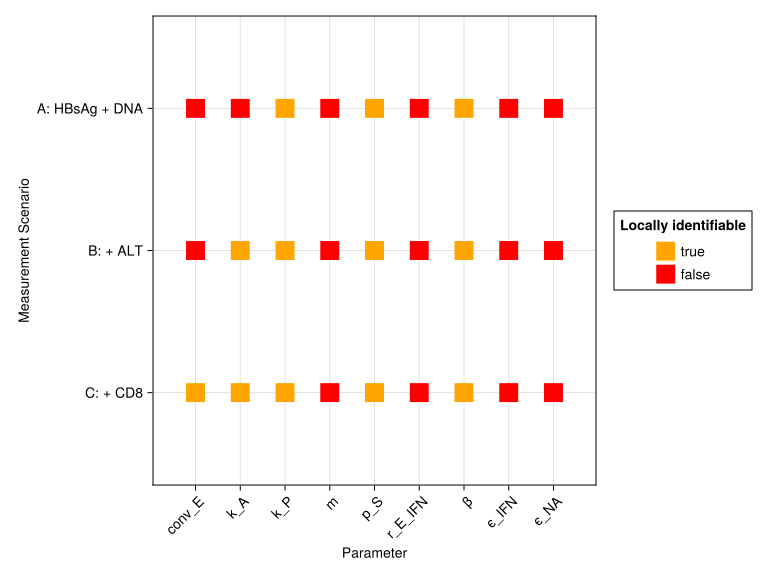
6.1 Identifiability Status by Scenario
specs = data(all_results) *
    mapping(
    :parameter => "Parameter",
    :scenario => sorter("C: + CD8", "B: + ALT", "A: HBsAg + DNA") => "Measurement Scenario",
    color = :local_identifiable => sorter(true, false) => "Locally identifiable",
) * visual(Scatter; markersize = 30, marker = :rect)
draw(
    specs,
    scales(Color = (; palette = [:orange, :red]));
    axis = (; xticklabelrotation = π / 4),
)
6.2 Summary: Impact of Measurements
result_counts = @by all_results [:scenario, :local_identifiable] begin
    :count = length(:parameter)
end
status_mapping = :local_identifiable => sorter(true, false) => "Locally identifiable"
specs = data(result_counts) * mapping(
    :scenario => sorter("A: HBsAg + DNA", "B: + ALT", "C: + CD8") => "Measurement Scenario",
    :count => "Number of Parameters",
    stack = status_mapping,
    color = status_mapping,
) * visual(BarPlot)
draw(specs, scales(Color = (; palette = [:green, :orange, :red])))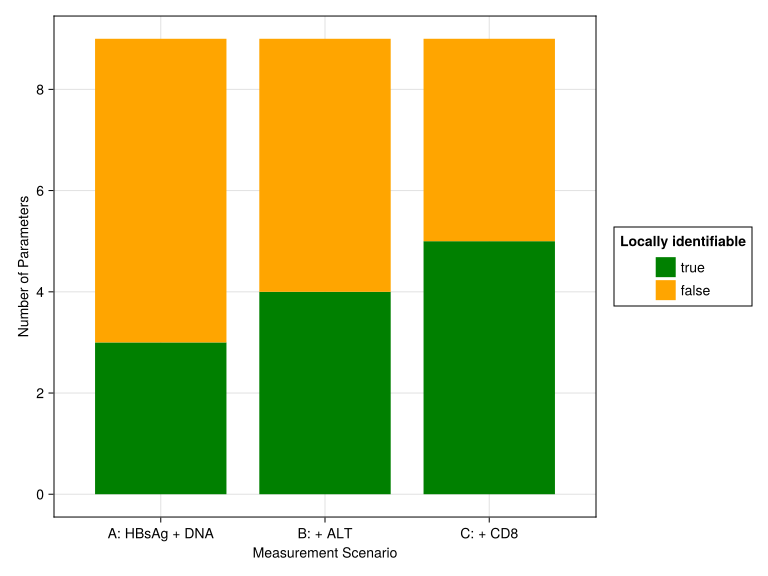
7 Summary
7.1 Key Takeaways
Non-rational functions (e.g., Hill functions with non-integer exponents) can be handled by introducing auxiliary state variables whose derivatives are rational
Measurement scenario matters: Adding clinical biomarkers (ALT, CD8 counts) can make previously non-identifiable parameters identifiable
Local analysis first: For complex QSP models, start with
assess_local_identifiability(fast screening) before running the more expensive global analysis
7.2 Quick Reference: Key Functions
| Function | Purpose |
|---|---|
assess_local_identifiability() |
Fast local analysis (identifiable yes/no) |
7.3 What’s Next?
In Tutorial 4: Copula Vpop Generation, we’ll generate a virtual population for the HBV model using Gaussian copula sampling.